
Rapid market validation is the process of testing a business assumption with real prospects before committing significant capital, and it is the single most reliable way to reduce launch risk. Entrepreneurs who skip this step routinely burn months and money building products nobody wants. AI-powered platforms now make it possible to validate new market opportunities quickly at a fraction of traditional research costs. AI-powered consumer research can cut validation costs by 93–96% and deliver results within 24 hours. That shift changes everything about how fast a business can move from idea to confident decision.
What does it take to validate new market opportunities quickly?
Speed in market validation does not come from cutting corners. It comes from having the right inputs ready before you run a single test. Three things must exist before any validation begins: a clearly defined target audience, a written list of assumptions, and a testable hypothesis for each assumption.
AI-powered consumer research platforms have made rapid validation accessible to solo founders and large teams alike. Individual audio interviews on AI platforms cost as little as $25 each, compared to $750–$2,500 for traditional qualitative methods. That cost gap means you can run 10 interviews for what a single focus group session used to cost.

The tools you choose to determine your speed. Survey builders like Typeform and Jotform handle quantitative signals fast. AI-moderated interview platforms handle qualitative depth at scale. For market sizing and trend context, federal databases and Google Trends provide free, reliable data within minutes.
| Method | Speed | Avg. Cost | Reliability |
|---|---|---|---|
| AI-moderated interviews | 24–48 hours | $25–$75 per interview | High |
| Online surveys | 48–72 hours | $50–$500 total | Medium |
| Expert panel interviews | 1–2 weeks | $500–$2,500 | High |
| Focus groups | 2–4 weeks | $3,000–$10,000 | Medium |
Pro Tip: Rank your assumptions by the one that, if wrong, would kill the idea entirely. Test that assumption first. Validating secondary assumptions before the core one wastes time and distorts your results.
How to execute a rapid market validation process step by step
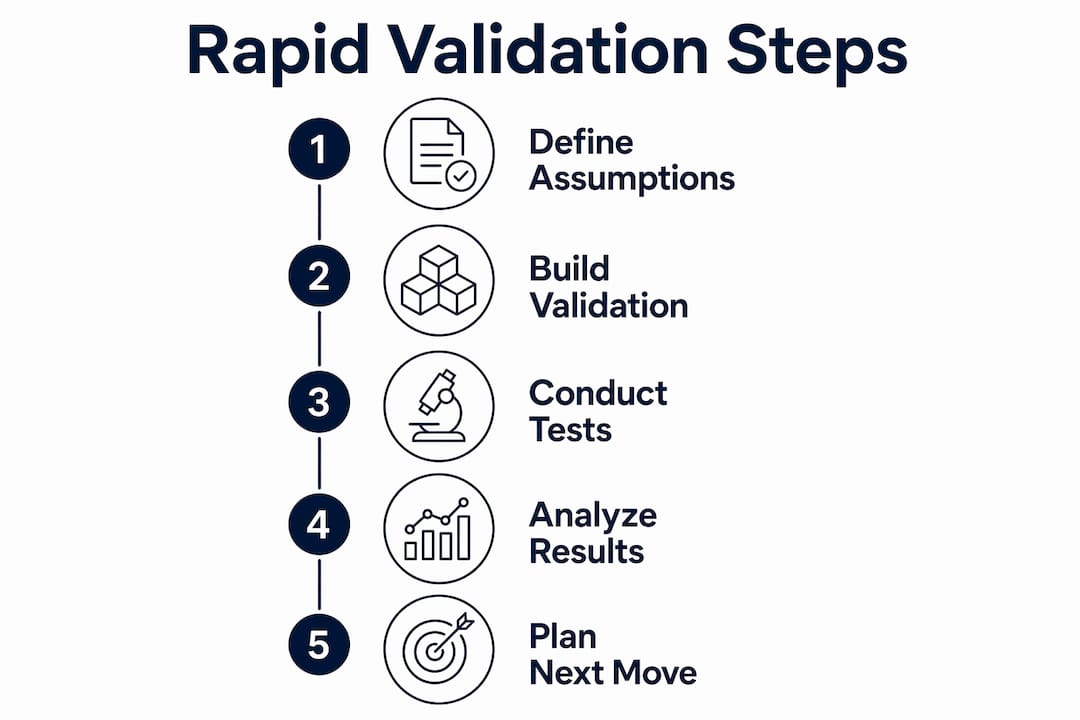
A structured process beats improvisation every time. The following five steps take most founders from raw idea to a clear go/no-go signal within 48 hours.
-
Define your target market and core assumptions. Write down exactly who you are selling to and what you believe to be true about their problem, willingness to pay, and current alternatives. Vague assumptions produce vague results.
-
Build concise validation tests. Each test should map to one assumption. A 5-question rapid validation framework lasting about 15 minutes per interview gives solo founders clear directional signals without exhausting participants.
-
Recruit participants fast. Online panels, LinkedIn outreach, and AI interview platforms can connect you with qualified respondents within hours. Aim for 10–15 interviews per hypothesis for reliable directional data.
-
Conduct interviews or surveys focused on binary metrics. Ask questions that produce a clear yes or no signal. Avoid open-ended exploratory questions at this stage. The goal is a go/no-go decision, not a research paper.
-
Analyze results within a 24–48 hour window and iterate. Score responses against your hypothesis. If the signal is ambiguous, adjust one variable and retest. Do not wait for perfect data before moving.
| Step | Time Required | Estimated Cost |
|---|---|---|
| Define assumptions | 1–2 hours | $0 |
| Build validation tests | 2–4 hours | $0–$50 |
| Recruit participants | 4–24 hours | $50–$300 |
| Conduct interviews/surveys | 24–48 hours | $25–$500 |
| Analyze and iterate | 2–4 hours | $0 |
One underused signal is the paid deposit test. Five or more deposits from cold contacts indicate real market demand. Zero to one deposits recommend dropping or reframing the idea entirely. Money from strangers is the clearest validation signal available.
Pro Tip: Keep interviews to 15–20 minutes maximum. Interviews longer than 20 minutes cause participant fatigue and reduce the clarity of the signals you receive.
What are the common mistakes that undermine rapid validation?
The most damaging mistake founders make is treating early-stage validation like ethnographic research. The goal of rapid validation is low-cost, timely go/no-go decisions, not deep cultural understanding. Seeking that depth before confirming basic demand wastes weeks and distorts priorities.
Common pitfalls that slow or invalidate the process include:
- Small sample sizes. Fewer than 10 interviews per hypothesis produces ambiguous results that feel meaningful but are statistically unreliable.
- Sunk cost bias. Founders who have spent weeks on an idea interpret weak signals as positive. Set your decision thresholds before you collect data, not after.
- Over-investing in qualitative detail too early. Detailed persona work and journey mapping belong after you confirm the problem exists and someone will pay to solve it.
- Testing the wrong audience. Recruiting participants who are curious rather than genuinely affected by the problem inflates positive signals.
- Skipping the price question. Willingness to pay is a core assumption. Validating the problem without validating the price leaves a critical gap.
Pro Tip: Use a binary decision framework before you begin. Write down: "We will proceed if X, and we will stop or pivot if Y." Committing to thresholds in advance removes emotion from the interpretation.
How to interpret validation results and plan your next move
Validation results fall into three categories: positive, ambiguous, and negative. Each requires a different response, and confusing them is where most founders lose momentum.
Positive signals include strong verbal confirmation of the problem, willingness to pay at your target price, and concrete behavioral evidence like deposits or pre-orders. When these align, move to the next stage of development or market entry planning.
Ambiguous signals require a targeted retest, not a full pivot. Adjust one variable, such as the audience segment or the price point, and run another small batch of interviews. Divergence patterns in industry metrics often precede strategic inflection points, signaling when to expand, consolidate, or exit a market. Treat ambiguity as a prompt to sharpen your hypothesis, not abandon it.
Negative signals are valuable. They save capital and time. A clear no from 10–15 qualified prospects means the current framing of the opportunity does not work. That is not failure. That is the process working correctly.
- Use federal databases like Census CBP, BLS QCEW, and FRED to benchmark industry data objectively over at least five years.
- Track employment, revenue, establishments, and wage trends across four dimensions to identify structural market shifts.
- Set a fixed review rhythm: monitor competitor campaigns weekly and broader market trend developments monthly.
Pro Tip: Set up a simple AI dashboard to monitor keyword trends and competitor activity on an ongoing basis. Early signals in trend data give you a head start before a market shift becomes obvious to everyone.
What quick market research methods speed up opportunity assessment?
Fast-tracking market analysis does not require a research team. The most effective quick market research methods combine free public data with AI-moderated consumer feedback.
AI-moderated interviews achieve 30–45% completion rates, which is 3–5 times higher than standard online surveys. Higher completion rates mean better data quality at the same cost. That reliability gap makes AI-moderated interviews the default choice for early-stage validation.
Practical methods to assess market trends and identify new opportunities fast include:
- Google Trends analysis. Compare search volume for your core problem keywords over 12–24 months. Rising trends confirm growing demand. Flat or declining trends signal a saturated or shrinking market.
- Federal industry data. Census CBP, BLS QCEW, and FRED provide employment and revenue data by industry code. Use these to size markets and spot structural growth patterns.
- Competitor activity monitoring. Track competitor ad spend, content publishing frequency, and product updates weekly. Increased competitor activity in a segment signals opportunity or saturation, and distinguishing between the two requires your validation data.
- Radar maps from digital activity. Mapping competitor digital footprints across channels reveals seasonal patterns and tactical gaps you can enter quickly.
- Parallel hypothesis testing. Running multiple small validation tests simultaneously, rather than sequentially, multiplies your learning rate without multiplying your budget.
Entrepreneurs who use the startup validation checklist approach, testing multiple hypotheses in parallel each week, consistently identify viable opportunities faster than those running one test at a time.
Key Takeaways
Rapid market validation works because it replaces expensive assumptions with cheap, real-world signals before any significant capital is committed.
| Point | Details |
|---|---|
| Start with written assumptions | Document every hypothesis before testing to keep validation focused and results interpretable. |
| Use AI-moderated interviews | AI platforms cut validation costs by up to 96% and deliver results within 24 hours. |
| Test 10–15 prospects per hypothesis | Fewer than 10 interviews produces unreliable signals; 10–15 is the minimum for directional confidence. |
| Set binary decision thresholds first | Define go/no-go criteria before collecting data to remove bias from interpretation. |
| Monitor trends on a fixed schedule | Weekly competitor checks and monthly industry data reviews catch market shifts early. |
Why speed beats depth in early-stage validation
Entrepreneurs consistently overestimate how much information they need before making a decision. I have watched founders spend three months building detailed market research decks for ideas that 10 interviews would have killed in a week. The research felt productive. It was not.
The shift that changes everything is treating validation as a series of cheap experiments rather than a single comprehensive study. Each experiment answers one question. If the answer is yes, you run the next experiment. If the answer is no, you adjust and rerun. That rhythm, repeated weekly, produces more viable opportunities than any amount of upfront analysis.
AI tools have made this rhythm genuinely accessible. Platforms that deliver validated startup insights in hours rather than weeks remove the excuse that speed requires sacrificing quality. The data quality from AI-moderated interviews is high enough for early-stage decisions. It is not perfect. It does not need to be.
The founders I respect most are not the ones who did the most research. They are the ones who learned the fastest. Speed and decisiveness in early validation free up time and capital for the stages where depth actually matters: product development, go-to-market execution, and scaling.
— Bogdan
Aiwmcquantis: built for entrepreneurs who need answers fast
Aiwmcquantis delivers business validation with document generation, instant quoting, and invoicing in 90 seconds. For entrepreneurs who need to assess market potential before committing resources, that speed is the difference between acting on an opportunity and watching someone else take it.
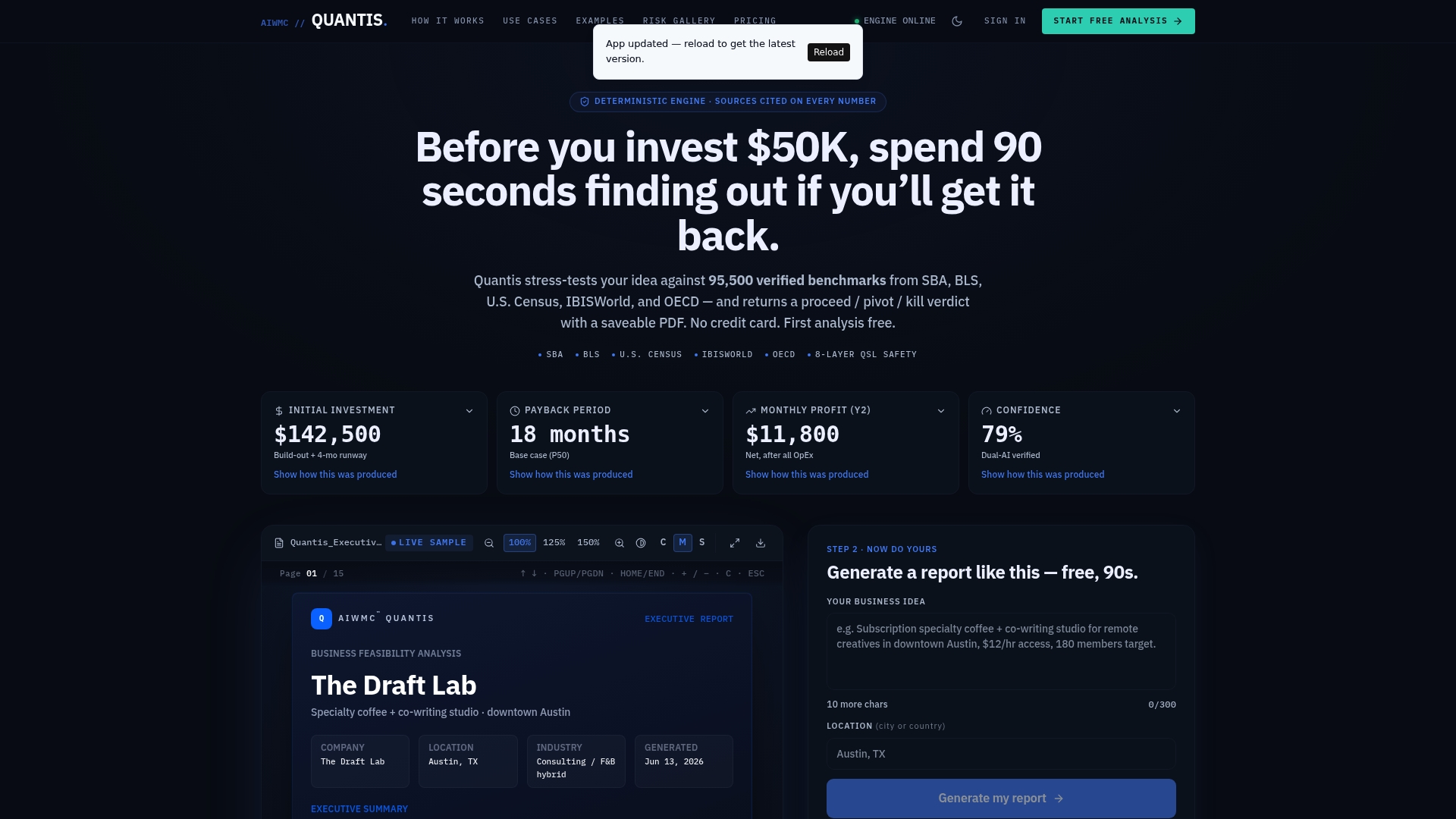
The platform is built for founders, investors, and consultants who run multiple validation cycles and need results they can act on immediately. Aiwmcquantis combines AI-driven analysis with practical business outputs so validation does not stop at a signal. It moves directly into planning. Explore the use cases for founders and investors to see how the platform fits your validation process, or try it free and get your first result in under two minutes.
FAQ
What is rapid market validation?
Rapid market validation is the process of testing a business assumption with real prospects using low-cost methods to reach a go/no-go decision within 24–48 hours.
How many interviews do I need to validate a market opportunity?
Ten to fifteen interviews per hypothesis is the minimum for reliable directional signals. Fewer than 10 produces results that are too ambiguous to act on confidently.
What is the cheapest way to validate a new market idea?
AI-moderated interview platforms offer individual interviews for as little as $25 each, making them the most cost-effective method for qualitative validation at speed.
How do I know if my validation result is a true positive signal?
Strong verbal confirmation of the problem, willingness to pay at your target price, and behavioral evidence like paid deposits from cold contacts are the clearest positive signals available.
What federal data sources help with market trend analysis?
Census CBP, BLS QCEW, and FRED are the most reliable sources for employment, revenue, and establishment data, covering at least five years of industry history for objective benchmarking.