
Business validation for financial clients is the process of confirming a company's legal existence, ownership structure, and risk profile before a financial institution or service provider engages with it. Known formally as Know Your Business (KYB), this process sits at the intersection of regulatory compliance and risk management. FinCEN's Customer Due Diligence Rule and global Anti-Money Laundering frameworks make it mandatory, not optional. Skipping or shortcutting the financial client validation process exposed institutions to $3.2 billion in AML fines in 2024 alone. That number reflects what happens when validation is treated as a checkbox rather than a governance function.
What are the essential steps in business validation for financial clients?
The financial client validation process follows a defined sequence. Each step builds on the last, and skipping any one of them creates a gap that regulators will find.
-
Entity verification. Confirm the legal name, registration status, and jurisdiction of the business. Pull records from state or national registries to verify the entity exists and is in good standing.
-
Beneficial ownership mapping. Identify every individual who owns 25% or more of the entity, plus anyone with significant control. This is the most time-consuming step for complex corporate structures.
-
Sanctions and PEP screening. Run the entity and its owners against OFAC's SDN list, UN sanctions lists, and politically exposed persons (PEP) databases. This step must happen before any funds move.
-
Adverse media checks. Search for negative news coverage, regulatory actions, or fraud allegations tied to the business or its principals. Reputational risk is a real compliance exposure.
-
Document authentication. Collect and verify incorporation papers, articles of organization, and incumbency certificates. Missing incumbency certificates cause 1–2 week onboarding delays when legal teams have to chase down signed documents after the fact.
-
Initial risk scoring. Assign a risk tier based on entity type, jurisdiction, industry, ownership complexity, and screening results. This score drives every subsequent decision about due diligence depth and monitoring frequency.
Pro Tip: Request all required documents in a single, structured checklist at the start of onboarding. Sending piecemeal requests is the single biggest driver of back-and-forth delays with client legal teams.
Automated processes cut onboarding time from 14–45 days manually to 7–14 days with integrated API checks. That reduction matters because faster onboarding means faster revenue and a better client experience without sacrificing compliance quality.

Why is beneficial ownership verification critical in financial client validation?
Beneficial ownership verification is the step that separates real KYB from superficial entity checks. KYB requires "looking through" entities to find the humans who actually control them, a process far more complex than standard Know Your Customer (KYC) checks on individuals.
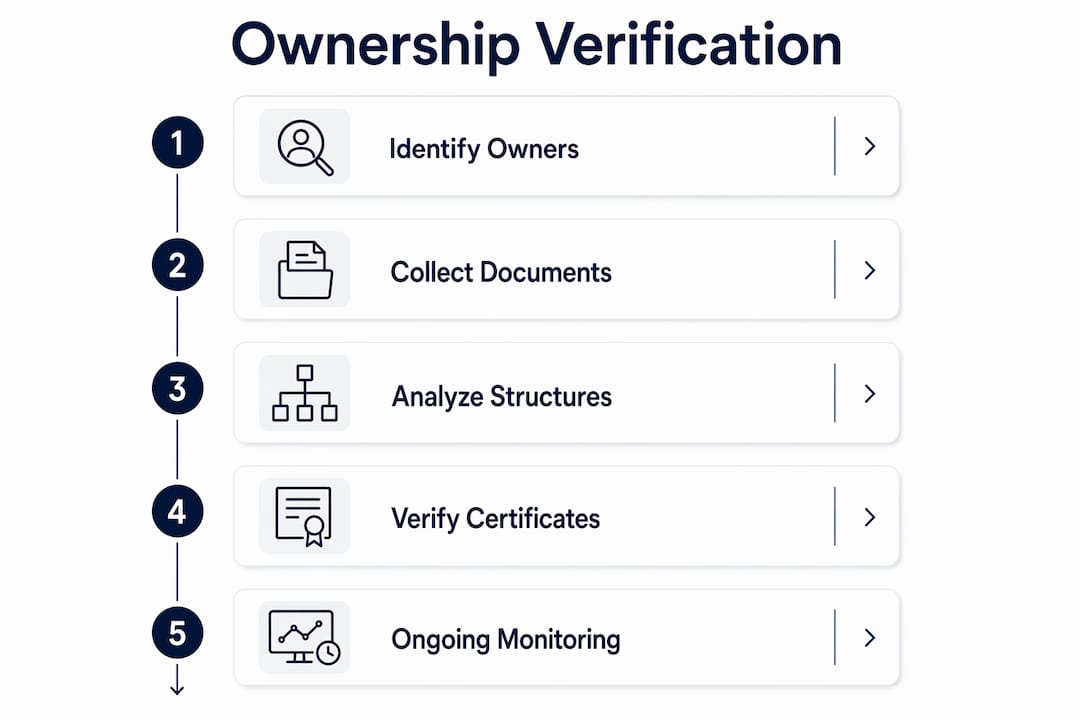
FinCEN's CDD Rule defines two prongs for beneficial ownership: the ownership prong (anyone holding 25% or more) and the control prong (a single individual with significant managerial control, regardless of ownership percentage). Both prongs must be satisfied for every covered legal entity.
The challenges that most teams underestimate include:
- Multi-layered holding structures. A business may be owned by a holding company, which is owned by a trust, which names a foundation as beneficiary. Each layer requires its own verification.
- Nominee arrangements. Some structures use nominees to obscure true controllers. Certified organizational charts are the primary tool for cutting through this.
- Jurisdictional gaps. Entities registered in jurisdictions with weak disclosure requirements make ownership verification harder and require additional document requests.
- Outdated records. Ownership changes after initial onboarding go undetected without ongoing monitoring triggers.
Certified organizational charts are key to avoiding "ownership blindness" in complex structures. Ownership blindness means a compliance team approves a client without knowing who actually controls the money. That is the scenario that produces AML penalties.
Pro Tip: Ask for a certified org chart at the document request stage, not after you have already started processing. Retrofitting ownership maps mid-onboarding is expensive and error-prone.
Failure to identify ultimate beneficial owners (UBOs) is one of the most cited deficiencies in regulatory enforcement actions. The $3.2 billion in AML fines recorded in 2024 reflects, in large part, failures at this exact step.
How does a risk-based approach optimize business validation and ongoing monitoring?
A risk-based approach means calibrating the depth of due diligence and the frequency of ongoing review to the actual risk level of each client. Not every business client needs the same scrutiny. Treating a low-risk domestic retailer the same as a high-risk cross-border payment processor wastes resources and slows onboarding for clients who pose minimal exposure.
The standard risk tier structure works as follows:
| Risk tier | Review frequency | Due diligence level | Common triggers for escalation |
|---|---|---|---|
| Low | Every 5 years | Standard CDD | Change in ownership, new jurisdiction |
| Medium | Every 3 years | Enhanced CDD | Adverse media hit, PEP connection |
| High | Annually | Full EDD | Sanctions proximity, complex structure |
Risk-based ongoing monitoring requires annual reviews for high-risk clients, every 3 years for medium-risk clients, and every 5 years for low-risk clients. These intervals are regulatory recommendations, not suggestions. Deviating from them without documented justification creates examination risk.
Enhanced Due Diligence (EDD) applies when a client hits specific triggers: a connection to a sanctioned jurisdiction, a PEP in the ownership chain, unusual transaction patterns, or a significant change in business activity. EDD means more documents, more source-of-funds verification, and senior management sign-off before approval.
Risk scores are less effective without a documented rationale file explaining why a client was accepted at a given tier. Regulators focus on the rationale, not the number. A score of "medium" means nothing if the file does not explain what drove that assessment and who approved it. The rationale file is the audit trail that protects the institution.
Continuous monitoring outperforms one-time checks because client risk profiles change. A business that was low-risk at onboarding may acquire a sanctioned subsidiary two years later. Automated monitoring tools flag these changes in real time rather than waiting for the next scheduled review.
What operational best practices improve business validation effectiveness?
Operational execution is where most validation frameworks break down. The policy may be sound, but the process falls apart when teams rely on informal judgments, inconsistent documentation, or manual workflows that do not scale.
The practices that produce consistent results are:
- Gather critical documents upfront. Build a standardized document checklist and send it at the first client contact. Onboarding delays come from missing signed legal documents, not from database checks. Collecting everything at once eliminates the most common bottleneck.
- Use integrated API checks for real-time screening. Manual sanctions screening against static lists is a compliance liability. Real-time API connections to OFAC, PEP databases, and corporate registries catch changes that manual processes miss.
- Document every decision with a rationale. Client acceptance controls protect firms at the point where risk enters by ensuring documentation, approvals, and escalation match the firm's risk appetite. Every acceptance or rejection needs a written record.
- Link approval authority to risk tier. Low-risk clients can be approved by a compliance analyst. High-risk clients require senior compliance officer or committee sign-off. This approval control matrix prevents informal overrides.
- Treat KYB as continuous governance. Client acceptance must be continuous governance protecting firms from risk at every stage, not just at onboarding. Periodic reviews, triggered re-screening, and transaction monitoring all feed back into the client's risk file.
Pro Tip: Build your document checklist around the worst-case scenario for your highest-risk client type. Then strip it down for lower tiers. Starting from the top prevents gaps that only surface during audits.
Aiwmcquantis supports this kind of structured validation workflow by generating the documentation and risk analysis that financial professionals need, in 90 seconds, without manual assembly. You can see how the risk calculation methodology works and apply it directly to your client assessment process.
Key Takeaways
Effective business validation for financial clients requires verified ownership, documented risk rationale, and continuous monitoring, not a one-time onboarding check.
| Point | Details |
|---|---|
| KYB goes beyond entity checks | Identifying beneficial owners and UBOs is the most complex and most regulated part of the process. |
| Document collection drives timelines | Missing incumbency certificates and corporate resolutions cause 1–2 week delays more than any database check. |
| Risk tiers set review frequency | High-risk clients need annual reviews; low-risk clients require review every 5 years per regulatory guidance. |
| Rationale files matter more than scores | Regulators examine the written justification for risk acceptance decisions, not just the numeric score. |
| Automation cuts onboarding time significantly | Automated workflows reduce onboarding from up to 45 days manually to as few as 7 days. |
The gap between policy and practice is where compliance fails
I have reviewed validation frameworks at financial firms that looked excellent on paper. The policies cited FinCEN, referenced FATF guidance, and included detailed risk matrices. Then I looked at the actual client files. Half of them were missing certified org charts. A third had no documented rationale for the risk tier assigned. Several high-risk clients had not been reviewed in four years.
The problem is not that compliance teams do not know what to do. The problem is that KYB is operationally hard, and most firms underestimate that difficulty until an examiner points it out. Ownership structures are genuinely complex. Clients push back on document requests. Analysts take shortcuts when they are processing 30 onboardings a month.
What I have come to believe is that KYB needs to be treated as a living governance function, not a gate you pass through once. The firms that handle it well have two things in common: they automate the repeatable checks, and they invest in the human judgment layer for complex cases. Neither alone is enough. Automation without judgment misses nuance. Judgment without automation does not scale.
The emerging use of real-time corporate registry APIs and AI-assisted adverse media screening is genuinely changing what is possible. But the technology only works if the underlying process is sound. If your rationale files are empty, better screening tools will not save you in an examination.
My advice: audit your existing client files before your regulator does. Look for missing org charts, undocumented risk decisions, and overdue periodic reviews. Fix those first. Then build the automation layer on top of a process that already works.
— Bogdan
How Aiwmcquantis supports your financial client validation process
Financial professionals who need structured, document-ready validation outputs do not have to build everything from scratch. Aiwmcquantis delivers business validation with document generation, instant quoting, and invoicing in 90 seconds, free to try.
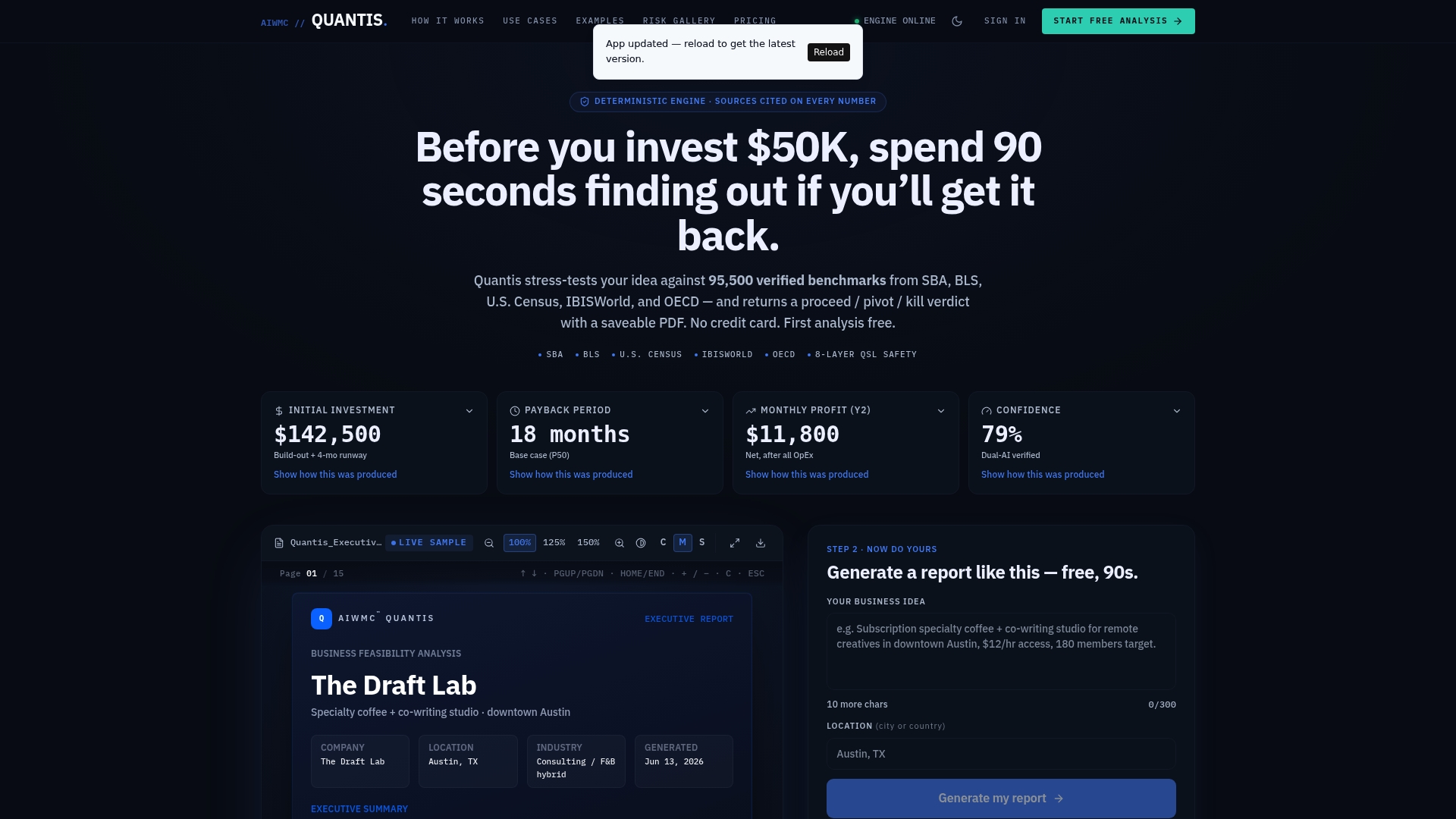
Whether you are validating a new business client, preparing a risk assessment file, or generating the supporting documentation for a compliance review, Aiwmcquantis produces the structured outputs that financial professionals need without the manual assembly time. The platform is built for founders, investors, and consultants who need validation results fast and in a format that holds up to scrutiny. See the full range of financial client use cases and find the workflow that fits your practice.
FAQ
What is KYB and how does it differ from KYC?
KYB (Know Your Business) verifies the legal existence, ownership structure, and risk profile of a business entity, while KYC (Know Your Customer) applies to individual persons. KYB is more complex because it requires identifying beneficial owners behind corporate layers, not just verifying a single individual's identity.
What documents are required for business validation?
Standard business validation requires incorporation papers, articles of organization, incumbency certificates, certified organizational charts, and government-issued ID for beneficial owners. Missing any of these, particularly incumbency certificates, typically causes 1–2 week onboarding delays.
What is the 25% beneficial ownership threshold?
FinCEN's CDD Rule requires financial institutions to identify any individual who owns 25% or more of a legal entity, plus one individual with significant managerial control. This threshold applies regardless of how ownership is structured across holding companies or trusts.
How often should financial clients be re-validated?
Regulatory guidance recommends annual reviews for high-risk clients, reviews every 3 years for medium-risk clients, and reviews every 5 years for low-risk clients. Significant changes in ownership, jurisdiction, or business activity trigger an immediate out-of-cycle review.
Why do risk scores need a rationale file?
A numeric risk score alone does not satisfy regulatory examiners. Regulators focus on the documented reasoning behind risk acceptance decisions, including who approved the client, what factors drove the tier assignment, and what conditions were attached to acceptance.